The Road to Sovereign AI
The Orwellian Reckoning:
AI as a Tool of Tyranny
For more than a decade before this story begins, HRF had watched authoritarian regimes learn to wield digital tools as instruments of control. Social media became surveillance infrastructure. Smartphones became tracking devices. Encrypted communications became targets. By the early 2020s, a new and more powerful tool had arrived: AI. China was leading the charge — harnessing machine learning for population surveillance, facial recognition at scale, predictive policing, and social credit systems. This was not theoretical. It was mass control infrastructure being exported to allied dictatorships worldwide. By 2024, the question for HRF was no longer whether AI was dangerous to civil liberties. It was: what do we do about it?

The Pivot: AI for Individual Rights Program
But then a strange thing happened. The technology that had appeared entirely in the service of authoritarian control began to show a different face — one pointed toward individuals. AI started becoming a tool that anyone could wield: to write, to build, to organize, to create. This wasn't obvious at first. But HRF was perhaps uniquely positioned to notice it early. In nearly two decades of operating, HRF had watched activists embrace technology after technology — the internet, encryption, Bitcoin — each one initially feared or dismissed, each one ultimately becoming a force multiplier for the people fighting for freedom. The pattern was familiar. And so, in a decisive pivot, HRF launched the AI for Individual Rights Program — betting that the same force enabling authoritarian control could, in the right hands, become the most powerful tool individual human rights defenders had ever had. Initial focus: funding research into exactly how authoritarian regimes were abusing AI, and what tools could make activists stronger. The threat and the opportunity were the same technology. And crucially, HRF understood something the tech industry had not fully grasped: human rights defenders and civil society organizations operate with skeleton crews and minimal budgets. The capabilities that a Fortune 500 company takes for granted — polished websites, video production, annual reports, marketing campaigns, app development — are simply out of reach for most NGOs. If AI could change that equation, it could change everything.
A New Word Enters the World:
"Vibe Coding"
The same month HRF was laying its groundwork, Andrej Karpathy coined a term that would reshape how humanity thinks about building software: vibe coding. The idea was radical — describe what you want in plain language, and let AI build it. Non-technical people could now create. The implications for human rights defenders were hard to overstate. These groups had always been outgunned on the creative and technical front: a dissident organization in Venezuela or a civil society group in Belarus couldn't afford the agencies, developers, and designers that a well-funded institution could. Vibe coding threatened to erase that gap entirely.
Non-Technical People Start to Create
Across the following months, a wave of tools — Replit, Lovable, and others — began unlocking creative and technical capabilities for people who had never written a line of code. Think about what this meant concretely for a small human rights organization: a team of three people in Nairobi or Minsk, running on donated funds, could suddenly produce a professional website, a polished annual report, a compelling video, a functional app — things that previously required hiring outside firms at costs they couldn't afford, or a creative team they'd never have the budget to staff. The playing field wasn't just tilting. It was being flipped.
A New North Star: Sovereign AI
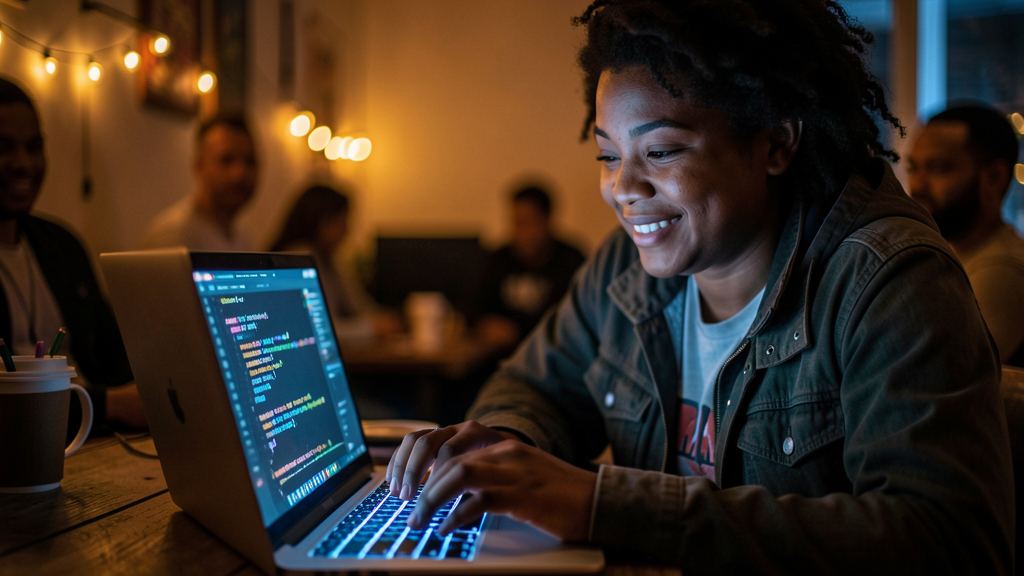
As 2025 progressed, HRF began coalescing around a powerful idea: it wasn't enough to give activists access to corporate AI tools. True freedom required sovereignty — the ability to run your own inference, own your own data, and operate beyond the reach of platform policies or government pressure. HRF began funding infrastructure for activists to run AI in their own way.
AI Summit for Individual Rights:
Dissidents Meet Technologists
For the first time, HRF brought together the dissident, policy, and technology communities in one room. The AI Summit for Individual Rights in San Francisco asked hard questions: What does sovereign AI look like for activists? How do we build infrastructure that can't be seized, blocked, or surveilled? The conversations were historic — and they produced a concrete action item: a hackathon.

First Grant Round:
8 Projects Funded
Announced alongside the AI Summit for Individual Rights, HRF deployed the first round of capital from the AI for Individual Rights Fund — supporting 8 grantees across two tracks. The first: open-source tools to give activists sovereignty over their AI (privacy-preserving inference, censorship-resistant access via Nostr, local-first coding agents). The second: education and capacity-building — developer courses, co-working cohorts, and consultation services to help rights defenders build and ship their own tools. Grantees included Maple AI, Routstr, OpenCode, PlebDevs, CANVAS/GENE, and Citizen Power Initiatives for China.
Claude Desktop Launches — AI Coding Goes Mainstream
Anthropic's Claude Desktop made local AI agents accessible to non-technical users for the first time at scale — you could describe a task in plain language and watch a computer carry it out. For the first time, people who had never written a line of code began building real software. The timing was not lost on HRF: this was precisely the tool that would power its first AI Hack for Freedom, held the same month in Austin.
AI Hack for Freedom:
A Weekend That Changed Everything
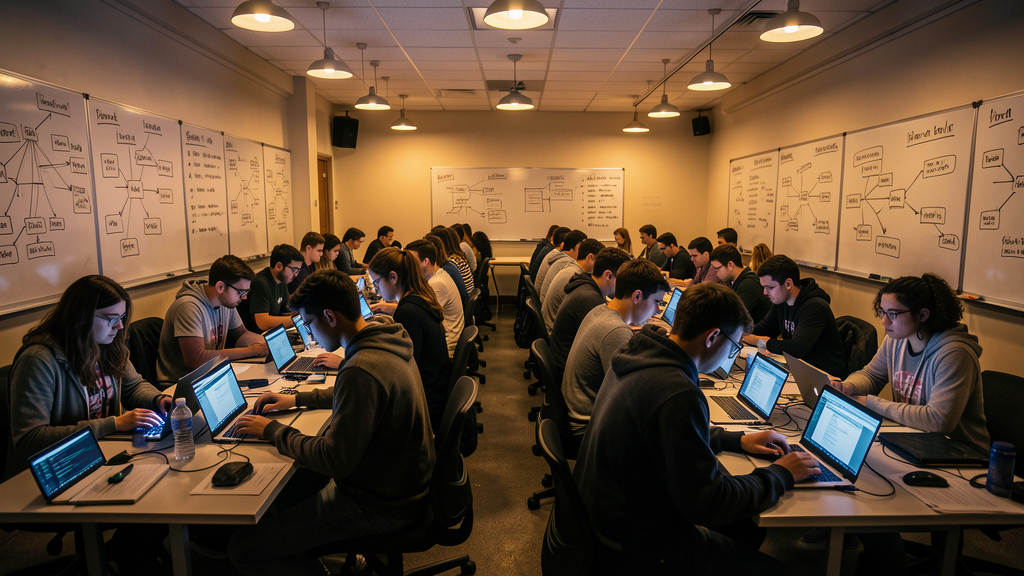
Six weeks after the Summit, HRF convened the first AI Hack for Freedom in Austin, Texas — timed precisely as Claude Desktop launched and the tools became genuinely powerful. In a single weekend, activist captains guided developers in building real, working technology. The activists couldn't write the code themselves yet — but they could articulate what they needed, direct the work, and push for what mattered. The developers held the keyboard; the defenders set the mission. It was a first step — and a vital proof of concept that the collaboration was possible.
Open Claw Goes Viral — Anyone Can Have an Agent
In January and February 2026, Open Claw spread across the internet and changed public perception of AI overnight. For the first time, millions of ordinary people saw what an AI agent actually looks like in action — not a chatbot answering questions, but a system that autonomously browses, decides, and executes on your behalf. The realization hit broadly and fast: this wasn't a tool for engineers or tech companies. Anyone could have a personal agent. For HRF's work with human rights defenders, the timing was electric — it was exactly the shift the program had been built to harness.
Second Grant Round:
10 More Projects Funded
HRF announced a second wave of 10 grants from the AI for Individual Rights Fund — doubling down on both tracks. On the open-source tooling side: projects giving activists private, local, permissionless AI access — including tools using Bitcoin's Lightning Network for pay-per-task AI in East Africa, a "VPN for AI inference" that anonymizes queries to closed models, compression techniques to run powerful LLMs on ordinary phones and laptops, and Enclave — a secure case management tool for political prisoners, conceived by Nicaraguan defender Berta Valle and first built at the AI Hack for Freedom hackathon. On the education side: new curricula targeting Gen Z and women in authoritarian countries, teaching vibe coding and how to deploy personal AI agents that expand their power rather than expose them. Supporting research grantees track CCP surveillance tactics and maintain the China Dissent Monitor — an AI tool that has logged over 14,000 cases of protest activity before censors can erase them.
Big Tech Bets on Open Source — Local Models Become Viable
In a striking signal of where the industry was heading, both Google and Nvidia released powerful open-weight models: Gemma 3 and Nemotron. These weren't hobbyist experiments — they were frontier-class models from two of the world's largest AI companies, released for anyone to run locally. The message was clear: even the biggest players were leaning into open source. For HRF, this was validation of the entire sovereign AI thesis — powerful intelligence that runs on your own hardware, beyond any government's reach, was no longer a distant dream. It was shipping.
AI Hack for Freedom II:
From Bystanders to Builders
Four months after Austin, HRF held the second AI Hack for Freedom in Nashville, Tennessee — and something had fundamentally shifted. This time, the human rights defenders weren't guiding developers from the sidelines. They were the developers. Armed with AI tools and the skills from Agent Camp, activists wrote, built, and shipped their own digital tools over a single weekend. It stands as one of the most profound demonstrations of what this program has achieved: the journey from bystander to creator, compressed into months. And it's worth pausing on what this means before we even get to the full local inference future. Stage one — cloud-based AI tools, vibe coding, personal agents — is already transformative. A human rights defender in Nashville who two years ago couldn't produce a website, a video, or an app without paying firms they couldn't afford, can now build all of it themselves, in a weekend, in a room full of peers. The final frontier of private local inference will matter enormously. But what's already true right now cannot be understated.
Agent Camp: 10 Defenders. Transformed.
HRF launched Agent Camp — intensive cohort training for the world's most prominent human rights activists, giving them a personal AI agent and the skills to use it. In the first batches, 10 of the world's most prominent human rights activists went from zero AI capability to steering complex coding projects — by speaking to a computer in plain language. The civilization step-change was real: in roughly six months, they went from observers to co-creators. These aren't hypothetical gains. Defenders who previously had to spend months fundraising to hire a developer, or go without a tool entirely, could now describe what they needed and have it built in an afternoon. PowerPoint decks, campaign websites, research reports, translation workflows, secure communications tools — the creative and operational output of a well-resourced team, available to anyone with a laptop and a good idea.
Building the Freedom Cluster:
Local & Private Inference
HRF began assembling its own compute cluster — hosted inference hardware that activists can use without relying on commercial API providers. Simultaneously, the Local Intelligence program started deploying hardware directly to NGOs and defenders. The goal: AI that runs entirely under your control, on your terms, unreachable by any corporation or government. Edge AI, local compute, open weights — the architecture of freedom.

Oslo Freedom Forum:
The AI Program Goes Public
The 2026 Oslo Freedom Forum is the coming-out party for HRF's AI program. In the Vibe Coding Lounge, attendees from every corner of the human rights world will sit down at a computer, describe their movement's needs, and watch AI build for them in real time. For many, it will be the first time they've ever used an agent. The demand for training — not corporate apps, but your own agent, running on your terms — is expected to be torrential.